

Confident and Wrong
AI made your security stack more persuasive, not smarter. In the first 72 hours, the most expensive mistake will be the one that sounded sure of itself.

AI did not make your security stack smarter. It made it more persuasive.
Those are not the same thing — and in a crisis, the distance between them is measured in the decisions you make because something sounded sure.
Picture hour nineteen of an incident. The summary on the screen says the breach is contained and customer data was not accessed. It is clean, well-structured, and completely confident. The CEO reads it, exhales for the first time in a day, and approves the note to customers. Twelve hours later, none of it is true. No one lied. A model made an inference, wrote it in the grammar of a fact, and a tired organization believed the writing.
For thirty years the security problem was that we did not know enough. Unknown assets, ambiguous alerts, noise we could not cut through. We assumed clarity was the cure — that if we could just get a clear, confident answer, we would be safer. AI has handed us clarity, and exposed the flaw in the assumption. The clarity is real. The correctness is optional. We optimized for signal and got fluency, and fluency is not truth.
Here is the uncomfortable part. A model’s confidence is a property of its prose, not of its accuracy. The tone has nothing to do with whether the thing is right. But human beings read confident, well-written language as competence — we always have — which means the writing quality of an AI finding is now, quietly, a security risk. The better it writes, the less we check. In a field that spent a decade hardening every other surface, we left the most exploitable one wide open: the human tendency to mistake a fluent answer for a correct one. The most dangerous finding in your next incident is not the one you missed. It is the well-written one.
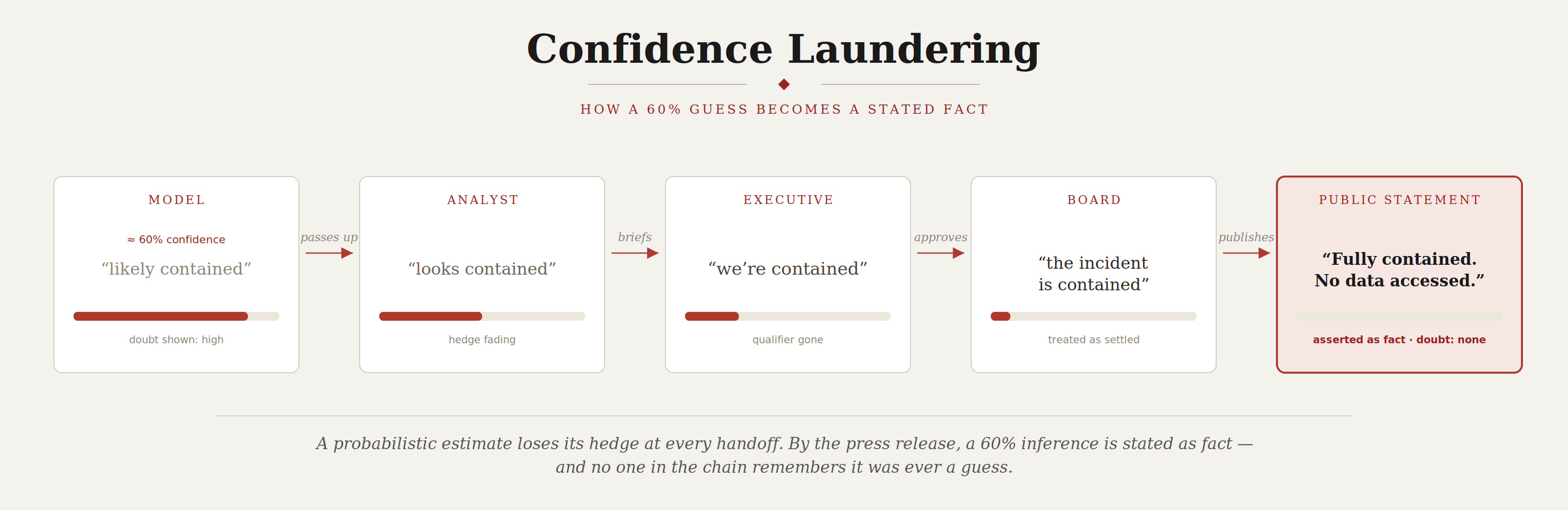
And confident wrongness does not sit still. It travels. The model emits a sure-sounding summary. The analyst, with no time to re-derive it, passes it up. The executive puts it in the board update. The board approves the public statement. At every handoff the hedge falls away and the guess hardens — until a 60-percent inference arrives at the press release wearing the word “fact,” and no one in the chain remembers it was ever a guess. Call it confidence laundering: the process by which a machine’s probabilistic estimate is cleaned of its uncertainty as it moves up the org chart. The first 72 hours are its perfect breeding ground — maximum pressure, no time to verify, and a desperate organizational appetite for good news.
Which is the trap inside the trap. The confident statement no one questions is almost always the reassuring one. We’re contained. It didn’t reach the customer data. This was the entry point and we’ve closed it. Under crisis pressure, nobody wants to interrogate good news — so the most dangerous confident error is precisely the one that lets the room breathe. The reassuring, fluent, wrong summary is the single most expensive artifact in incident response, and it is about to become far more common.
So the discipline has to shift. The old craft was detection — finding more. The new craft is calibration — knowing how often your machine is right when it sounds right. A calibrated system that says “ninety percent” is correct ninety percent of the time. Most AI output is not calibrated, and fluency makes it worse, because the machine never sounds unsure even when it is. You cannot fix that by trusting the tone. You fix it by demanding the evidence under the conclusion — the sources, the reasoning, the blast radius — and by measuring, over time, the gap between how sure the thing sounds and how often it is right.
But calibration is a tool, and this is a leadership problem before it is a tooling one. Under pressure, organizations defer to the most confident voice in the room. For most of history that voice was a person — and at least a person could be read, doubted, asked “are you sure?” Now the most confident voice is a machine that never hedges, never tires, and never betrays a flicker of doubt, and it is speaking into the exact moment when everyone most wants to be told it will be okay.
That inverts the job of leadership. In the first 72 hours, your value is no longer to have the answer. The machine will always have an answer. Your value is to know which answers deserve to be questioned — to install doubt where the machine installs certainty. The most important person in the room is not the one who can produce a confident summary. It is the one who can look at a confident, fluent, reassuring summary and ask, how sure are we, really — and what would change that? Call it calibrated skepticism, and start treating it as an executive competency, because it is about to be one of the most valuable.
This cuts against where the whole industry is heading. Every vendor is racing to make AI sound more confident and more human — fewer hedges, cleaner answers, smoother demos. For security, that is exactly backwards. You should want the opposite: a system that surfaces its uncertainty out loud, that says “I’m sixty percent on this, and here is what would move me,” even though it demos worse and feels less impressive. Legible doubt is a feature, not a flaw. A security AI that never admits it is unsure is not advanced. It is dangerous.
The hardest discipline of the next few years will not be teaching machines to be right. They will be right most of the time — that is the whole problem, because “most of the time” is what earns the blind trust that the rest of the time exploits. The hard part is teaching people, and especially leaders, to tell the difference between an answer that is correct and an answer that merely sounds correct — fast enough to matter, in the worst 72 hours of the company’s life.
So when the summary is clean and the model is sure and the room exhales, do the unnatural thing. Treat every confident machine statement as a hypothesis until it has earned the word “fact.” Especially the ones you were hoping to hear.